Our Story
FOUNDING
STORY
It was an ordinary Tuesday in a hotel bar that had no business being so quiet. The year was 2021, the city was somewhere between one set of Covid-19 restrictions and the next, and two people who had spent their working lives at very different desks found themselves with the kind of unstructured evening that lockdown manufactured by accident: too much time, not enough to fill it with. What they talked about, eventually, was furniture. Not as decoration. As inheritance, as instinct, as the thing each of them had quietly known something about long before either had a reason to say so out loud.
One had spent his afternoons as a teenager in his family's small vintage Korean furniture store, a venture his father had started with a colleague for the simple pleasure of being around old, well-made things. He knew, before he could have explained it, the particular weight of a drawer built to outlast its owner, the smell of varnish on teak left too long in a humid room, the specific disappointment of furniture that looked right in a showroom and wrong everywhere else. A decade later, furnishing his own home, he ran into that disappointment again: everything on offer in Singapore was either mass-produced and forgettable, dated beyond rescue, or priced for a name rather than for the work itself. There was, as far as he could tell, nothing in between.
The other had grown up in Japan, where the discipline of taking things away rather than adding them isn't something you're taught so much as something you absorb by living somewhere it's simply assumed. An eye trained that early doesn't announce itself. It shows up later, in what gets left off a piece rather than what gets put on it.
What began that evening as conversation became, over the following months, a hobby: a way of using a year with no social calendar and few public places to be in. It found an audience faster than either of them expected. A few years on, both left their respective corporate careers they had spent a decade building to run what had started as a side project full time.
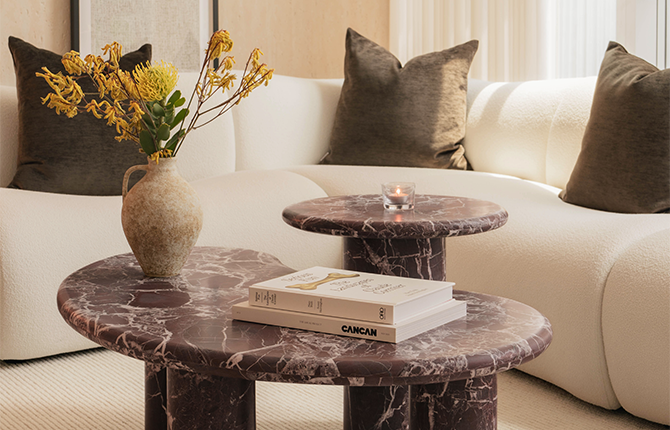
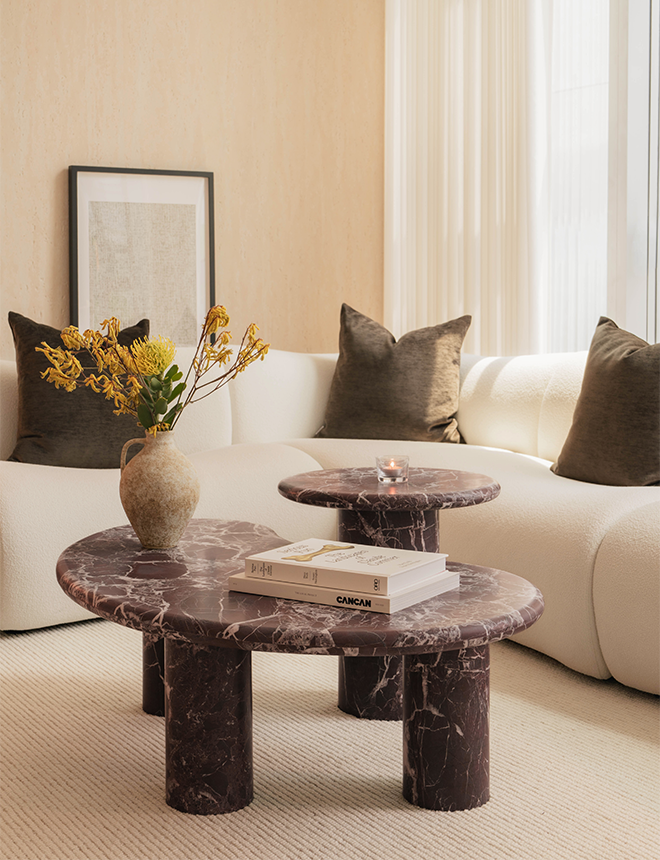
That history is still legible in how the work gets done. CANCAN does not commit to a single material story, because Singapore never has. The city has spent two centuries deciding what passes through is worth keeping, and the practice here is much the same: travertine quarried near Rome, marble drawn from quarries in France, Brazil, Iran, China and Italy, each block chosen for a particular vein or hardness rather than to fit a house style. The manufacturing partners behind each piece have been checked, and checked again, over years of working together, not because provenance is a selling point but because it is the only way to know a piece will still be honest in ten years.
A good deal of what gets made here never reaches a catalogue at all. An architect needs a single sculptural anchor for a lobby. A restaurant needs forty covers of seating that refuse to read as forty identical chairs. A home has not one standard dimension on its floor plan. This is the part of the work that resists templates, and it is usually the part worth doing.
The showroom was built with that in mind: less a place to browse than a place to handle a stone sample under real light, to sit in a configuration before committing to it. The relationship does not end at delivery. Years later, there are still questions worth answering, about how a patina develops, how a finish holds up against the particular humidity of this climate, how a piece travels when a home changes.
Furniture bought well outlives the year it was bought in, and very often outlives the people who bought it. What two strangers worked out over drinks one quiet evening, in a city built on knowing what to keep, was that this was worth doing properly.